Brand · Class A
Blue Bird Wanderlodge
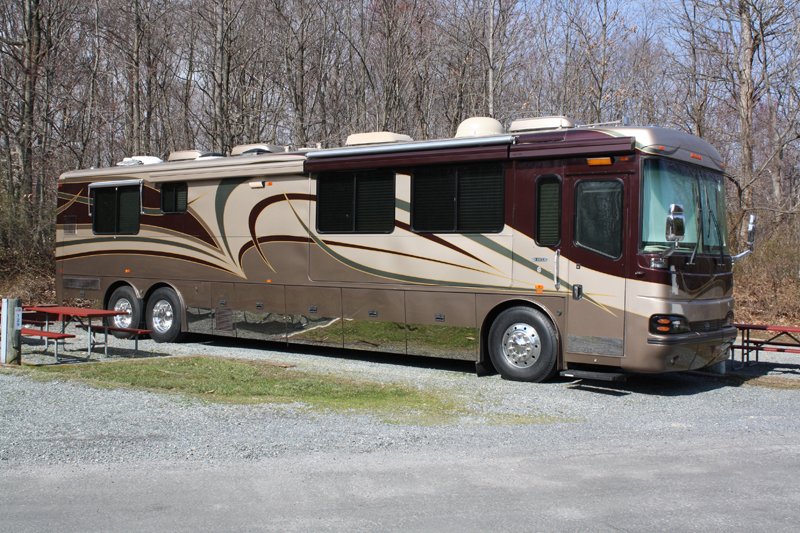
2006 Blue Bird Wanderlodge Class A motorhome · bus-stuff.com · Source ↗
Wanderlodge was the luxury motorhome line of Blue Bird, the school bus builder in Fort Valley, Georgia. It began in 1963 as the Blue Bird Transit Home, built on the company’s All American bus, and took the Wanderlodge name by 1968. Wikipedia credits its school-bus chassis and all-steel body for its name for durability, and Blue Bird’s 2004 brochure still stressed a stainless steel body built as one unit with the chassis. Blue Bird sold the line in 2007, and production ended in 2009.
Fact-checked. An independent reviewer checked this page against its cited sources.
All the models
Models, top of the line first
| Model | Type | Years made | Price when new | Years on file |
|---|---|---|---|---|
| M450 LXi · no longer built | Class A | Ended 2009 | Not documented | 2 |
| LXi · no longer built | Class A | 1998 – 2003 | Not documented | 6 |
| LX · no longer built | Class A | 1998 – 2003 | Not documented | 6 |
| WB · no longer built | Class A | 1988 – 1997 | Not documented | 12 |
| PT · no longer built | Class A | 1982 – 1992 | Not documented | 7 |
| M380 · no longer built | Class A | 2003 – 2009 | Not documented | 3 |
| BMC · no longer built | Class A | 1994 – 1997 | Not documented | 5 |
| SP · no longer built | Class A | 1989 – 1992 | Not documented | 4 |
| FC · no longer built | Class A | 1963 – 1989 | $25,000 (1968) | 55 |
Choose a model to see every model year on file. Prices are the documented price when new for the year shown, not a used value.
The full story
Blue Bird Wanderlodge history
Blue Bird started as a school bus builder in Fort Valley, Georgia. Albert L. Luce Sr., a Ford dealer, finished his first bus in 1927 and formed the Blue Bird Body Company in 1932. He died in 1962, and his three sons, George, Albert Jr. (called Buddy) and Joseph, ran the company. Buddy Luce was its president.
In October 1963 Blue Bird showed a motorhome built on its All American school bus. It was called the Blue Bird Transit Home and was priced at $12,000. A new subsidiary, Cardinal Manufacturing Co., built it. Few buyers came at first, even after the prototype was sent on a long tour of campgrounds. In 1965 House Beautiful magazine ran a story on land yachts that included the coach. Five orders followed, and regular production began that year.
By 1968 the coach had a new name, Wanderlodge, and its price had climbed to $25,000. The Vintage Birds owners’ club model list says it came only as a 31-foot coach with a gasoline engine through 1973, that a 33-foot model was added for 1974 and a 35-foot model for 1975, and that a Caterpillar 3208 diesel arrived in 1977. Wikipedia says the diesel had fully replaced the Ford gasoline engines after 1978. Each coach was built to its buyer’s order, and by the late 1980s the option list ran to about 200 items.
Wikipedia says the Wanderlodge was built like a bus, with a chassis taken from the All American school bus and an all-steel body, and credits that construction for the coach’s name for durability and quality. Blue Bird made the same point decades later: its 2004 brochure described a stainless steel body built as one unit with the chassis and said this gave more structural strength than a fiberglass motorhome.
The club’s list and Wikipedia say rear-engine coaches joined the line for 1982. These PT models had Detroit Diesel two-stroke engines and, Wikipedia adds, a tag axle, and came in 35- and 40-foot lengths. The front-engine coaches were then called FC, for forward control. A 102-inch Wide Body followed for 1988, and a 36-foot single-axle pusher, the SP, for 1989. The last forward-control coaches were 1989 models.
By the late 1980s Blue Bird was selling about 150 to 200 Wanderlodges a year, about a fifth of company sales. Prices started at $199,000, and the top model cost $350,000 before options.
In 1992 Merrill Lynch Capital Partners bought 82 percent of Blue Bird in a buyout led by the company’s managers, who took the rest, and the company passed out of Luce family hands. Wikipedia says the motorhomes had been restyled for 1991 to remove almost every visual link to the school bus, and that the BMC (Blue Bird Motor Coach), added for 1994, was a 37-foot coach on a chassis from Spartan Motors rather than Blue Bird’s own. The club’s list adds a 42-foot Wanderlodge with a Detroit Diesel Series 60 for 1995.
A new generation arrived for 1998; Wikipedia says it was based on Blue Bird’s LTC-40 intercity coach. The club lists the 40-foot LX with a Cummins M11 engine and the 41- and 43-foot LXi with a 500-horsepower Detroit Diesel Series 60. Both sources say slide-out rooms came in during these years and were on every coach by 2002. Henlys Group, a British bus company, bought Blue Bird in 1999. Wikipedia says the 38-foot M380 was added for 2003, and a 2004 brochure shows the top model as the Wanderlodge 450 LXi with a 525-horsepower Caterpillar C13.
After a 2006 bankruptcy filing, Blue Bird came under Cerberus Capital Management and its Traxis Group, and the company decided to build only school buses. In July 2007 it sold its Wanderlodge and Coachworks lines, with the Fort Valley plant that built them, to Complete Coach Works of Riverside, California. Coachbuilt.com says the Wanderlodge rights went to Coachworks Holdings Inc., and Wikipedia says the 450 LXi and M380 stayed in production without the Blue Bird name. Coachworks Holdings stopped building coaches in April 2009 and went bankrupt. Its assets were auctioned in Fort Valley on October 15, 2009, and bus converter Parliament Coach of Clearwater, Florida, bought the company’s intellectual property, including its technical records, and the rights to the Wanderlodge name so that owners would still have support.
- 1932Blue Bird Body Company is formed
Ford dealer Albert L. Luce Sr., who finished his first bus in 1927, sets up the Blue Bird Body Company in Fort Valley, Georgia, to build school buses. Source ↗
- 1963Transit Home introduced
In October 1963 Blue Bird introduces a motorhome based on its All American bus, the Blue Bird Transit Home, priced at $12,000 and built by a new subsidiary, Cardinal Manufacturing Co. Source ↗
- 1965Magazine story brings the first orders
House Beautiful runs a story on land yachts that includes the Transit Home. Five orders follow and sales pick up. Source ↗
- 1968Renamed Wanderlodge
By 1968 the Transit Home name has been dropped for Wanderlodge, and the price has risen to $25,000. Source ↗
- 1969Nine rear-engine coaches
Blue Bird builds nine 35-foot rear-engine coaches with Ford gasoline engines, years before a rear-engine model joins the regular line. Source ↗
- 1974–1975Longer coaches
A 33-foot model is added for 1974 and a 35-foot model for 1975. Until then the 31-foot coach was the only size. Source ↗
- 1977Diesel power
The Caterpillar 3208 diesel becomes the factory engine, though early 1977 coaches still have gasoline engines. Source ↗
- 1979Fifteenth-anniversary XV
A 35-foot anniversary coach called the XV is built with the Caterpillar 3208. Vintage Birds calls it a forerunner of the later pushers. Source ↗
- 1982PT rear-engine models
The PT 35 and PT 40 pushers join the line with Detroit Diesel two-stroke V6 engines. The forward-control coach gets a new bathroom and dashboard. Source ↗
- Late 1980sA $199,000 to $350,000 motorhome
Blue Bird sells about 150 to 200 Wanderlodges a year, roughly a fifth of company sales. Prices start at $199,000, and the top model costs $350,000 before options. Source ↗
- 1988Wide Body and 25th anniversary
A 102-inch Wide Body arrives in 38- and 40-foot lengths, along with a 475-horsepower Detroit Diesel 8V92TA with DDEC. A 40-foot XXV model marks 25 years. Source ↗
- 1989SP arrives, forward control ends
A 36-foot single-axle pusher, the SP, is introduced with a 300-horsepower Caterpillar 3208. It is the last model year for the forward-control coach. Source ↗
- 1991New look
The Wide Body and SP get a new exterior and major equipment changes. Source ↗
- 1992Blue Bird changes hands
Merrill Lynch Capital Partners buys 82 percent of Blue Bird for $397 million in a buyout led by company managers. Source ↗
- 1994BMC introduced
The 37-foot BMC, short for Blue Bird Motor Coach, is introduced. Source ↗
- 1998LX and LXi
A new generation debuts: the 40-foot LX with a 450-horsepower Cummins M11 and the 41- and 43-foot LXi with a 500-horsepower Detroit Diesel Series 60. Source ↗
- 2003M380
Production of the M380 begins. All but one of the 2003 coaches have a single slide-out. Source ↗
- 2004Wanderlodge 450 LXi brochure
A factory brochure dated 2004 presents the Wanderlodge 450 LXi with a 525-horsepower Caterpillar C13, an Allison six-speed and a stainless steel body built as one unit with the chassis. Source ↗
- 2007Sold to Complete Coach Works
In July 2007 Blue Bird sells its Wanderlodge and Coachworks lines, with the Fort Valley plant, to Complete Coach Works of Riverside, California, to focus on school buses. The line then includes the 450LXi and M380. Source ↗
- 2009Production ends
Coachworks Holdings Inc. stops building Wanderlodges in April 2009. Its assets are auctioned on October 15, and Parliament Coach of Clearwater, Florida, buys the firm’s intellectual property and the rights to the Wanderlodge name. Source ↗
Brochures and sources
- Blue Bird Wanderlodge (Wikipedia) ↗
- Highlights of all Blue Bird Wanderlodge Model Changes (Vintage Birds Chapter of FMCA) ↗ — Owner-club (FMCA chapter) list of Wanderlodge model changes for every year from 1963 to 2004: lengths, engines and body codes.
- 1979 Blue Bird Wanderlodge page (Vintage Birds Chapter of FMCA) ↗ — Example of the club’s year pages; those for 1977–1980 and 1983–1987 carry standard-specification blocks for the forward-control coach. Replace the year in the address for other years; most later pages hold photographs only.
- Wanderlodge 450 LXi factory brochure, copyright 2004 Blue Bird Corporation (form RV-LXi-0704) ↗ — Factory brochure, 16 pages, full specification list and two floor plans; no model year printed.
- The Blue Bird Wanderlodge M380 factory brochure (undated) ↗ — Factory brochure, 7 pages, main specifications; undated, Henlys-era.
- Blue Bird manuals index (ManualsLib) ↗ — Owner-preserved factory documents: 1964 Transit Home Q&A, owner’s manuals for 1967, 1983, 1986 WLPT, 1987, 1989 Wide Body Pusher, 1994 Wide Body and 2003 M380. Only titles, page counts and some contents lists could be read in this session.
- Wanderlodge Owners Group ↗ — Owners’ club that hosts scanned factory manuals, including the 1964 Transit Home brochure linked by The Autopian. The site refused the research tool (HTTP 403), so its contents were not verified in this session.
- Blue Bird company history (Coachbuilt.com) ↗ — Company history from the 1927 first bus through the 2009 auction; covers the October 1963 introduction, Cardinal Manufacturing, the 1968 rename and the 2007–2009 sale and shutdown.
- Blue Bird Corporation history (International Directory of Company Histories, via FundingUniverse) ↗ — International Directory of Company Histories entry (Vol. 35, St. James Press, 2001; no individual author is named on the page): 1963 introduction, 1965 House Beautiful story, late-1980s volume and prices, 1992 and 1999 ownership changes.
- Blue Bird Wanderlodge (Wikipedia) ↗ — Generation-by-generation history with model list; cites Vintage Birds, archived Blue Bird web pages and a 1987 New York Times article.
- Blue Bird Corporation (Wikipedia) ↗ — Corporate history of the parent company, including the 1991–1992 buyout, 1999 Henlys sale, 2006 bankruptcy and the 2007 Wanderlodge sale.
- Blue Bird Sells Its Coach, Motorhome Lines (School Bus Fleet, July 16, 2007) ↗ — Trade-press report of the July 2007 sale to Complete Coach Works with executive quotes.
- Blue Bird sells its coach bus, motorhome lines (Metro Magazine, July 16, 2007) ↗ — Same-day report of the 2007 sale.
- Coachworks to Cease Operations, Blue Bird Unaffected (School Transportation News, April 29, 2009) ↗ — April 29, 2009 report that the former Coachworks and Wanderlodge business was going out of business and selling its assets.
- Converter Parliament Coach Buys Blue Bird Assets (RV Business, via MotorHome magazine archive) ↗ — Parliament Coach buys the Wanderlodge technical records at the Coachworks Holdings bankruptcy auction; cites about 3,500 Blue Bird coaches in use.
- The Classic Ride: 1991 Blue Bird Wanderlodge (MotorHome magazine) ↗ — MotorHome magazine profile of a 40-foot 1991 Wide Body with a Detroit Diesel 8V92.
- The Wanderlodge Is A Luxury RV Built By A School Bus Manufacturer (The Autopian, July 28, 2022) ↗ — Feature article; describes the 1964 brochure and quotes the 1987 New York Times report on prices and options.
- NHTSA manufacturer record: Coachworks Holdings Inc, One Wanderlodge Way, Fort Valley, GA ↗ — Federal manufacturer record for Coachworks Holdings Inc at One Wanderlodge Way, Fort Valley; vehicle types listed as bus, incomplete vehicle and multipurpose passenger vehicle.
Links open the original page. Facts are checked against these sources; tell us if you find one that is out of date.
Blue Bird Wanderlodge coaches for sale
See Blue Bird Wanderlodge listings in the Motorcoach.direct marketplace.