Brand · Bus conversion
Prevost
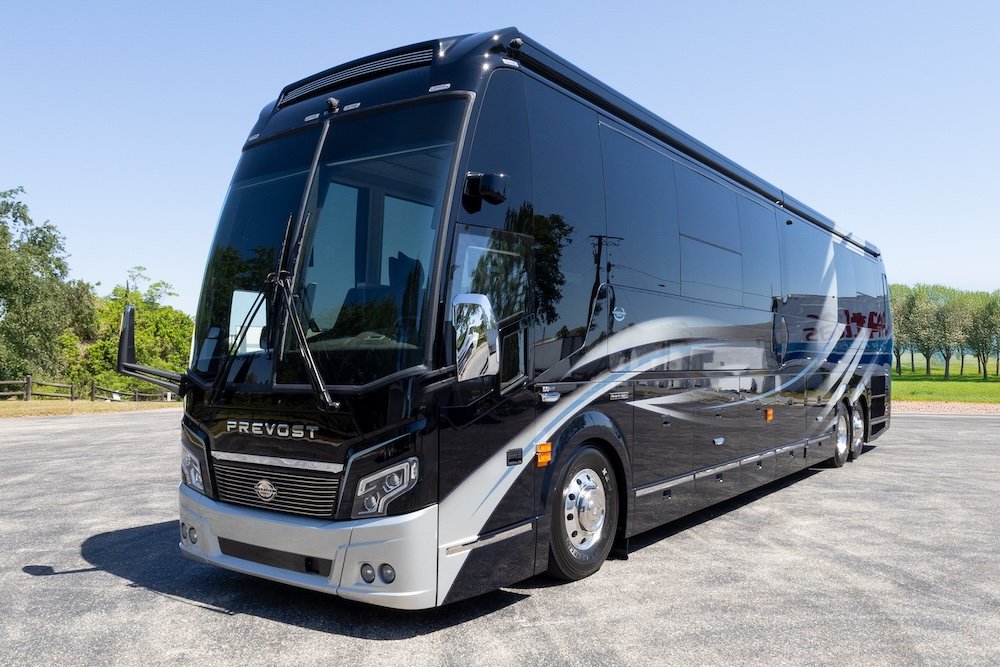
2025 Marathon Prevost H3-45 VIP Class A motorhome · Prevost-Stuff · All rights reserved · Source ↗
Prevost is a bus maker based in Sainte-Claire, Quebec, and founded in 1924. It builds passenger coaches for tour, intercity and commuter service. It also builds bus shells with nearly empty cabins that outside companies, called converters, finish as luxury motorhomes and entertainer coaches. Prevost has been wholly owned by Sweden's Volvo since 2004, after nine years of joint ownership with Britain's Henlys Group.
Fact-checked. An independent reviewer checked this page against its cited sources.
All the models
Conversion shells
| Model | Type | Years made | Price when new | Years on file |
|---|---|---|---|---|
| H3-45 VIP | Bus conversion | 2021 – 2023 on file | Not documented | 3 |
| X3-45 VIP | Bus conversion | 2023 on file | Not documented | 1 |
| XLII · no longer built | Bus conversion | Not documented | Not documented | 0 |
| XL-45 · no longer built | Bus conversion | Not documented | Not documented | 0 |
| Le Mirage XL · no longer built | Bus conversion | Not documented | Not documented | 0 |
| H3-40 VIP · no longer built | Bus conversion | Not documented | Not documented | 0 |
| Le Mirage · no longer built | Bus conversion | Not documented | Not documented | 0 |
Choose a model to see every model year on file. Prices are the documented price when new for the year shown, not a used value.
The full story
Prevost history
Prevost began in 1924 in Sainte-Claire, Quebec. Eugène Prévost was a cabinetmaker who made church pews and school furniture. That year he was asked to build a wooden coach body and mount it on a new REO truck chassis. The company built its first bus plant in Sainte-Claire in 1937, and in 1945 it introduced its first all-metal body over an all-metal frame.
In 1957 Paul Normand bought the company, and it was renamed Prevost Car. Its business was passenger coaches: buses sold to the companies that run tours and intercity routes. The 1966 Champion had three axles, a split-level floor and air conditioning. Prevost describes it as the first North American coach with an integral structure. That means the frame and body are one welded unit, not a body set on a separate chassis. Wikipedia says the Champion was the first Prevost marketed in the United States. BUSRide reports that at about that time Prevost opened its first US sales and service centers, in Lyndhurst, New Jersey, and Los Angeles.
The motorhome business grew out of the bus business. In 1969 two American businessmen, Thomas B. Harbison and William G. Campbell, formed a partnership with André Normand to own Prevost. Both were longtime motorhome owners. In 1970 the first Champion conversion shell left the assembly line. A conversion shell is a bus built with a nearly empty cabin so that another company can finish the inside. In 1978 Prevost showed its first Le Mirage conversion shell at the Family Motor Coach Association meeting. Harbison and Campbell had helped engineer it.
In 1984 Prevost moved to a 102-inch-wide body with the Le Mirage XL and the Prevost XL, sold both as passenger coaches and as conversion shells. A second line, the H-Series, began in 1985 with the H5-60, a 60-foot articulated bus. BUSRide's timeline says the H3-40 followed in 1989, both as a touring coach and as a shell for conversion. In 1992 came the 45-foot XL-45, introduced for traveling entertainers. Prevost's motorhome history page says that in 1993 it launched the H3-41 and H3-45 touring coaches together with the H3-45 VIP, a bus shell for high-end conversion.
In 1995 Volvo of Sweden and Henlys Group of Britain took joint ownership of Prevost. In October 2004 Volvo agreed to buy the Henlys half for 83 million US dollars, a price that included two loans Henlys had made to the company. Prévost Car Inc., which by then also held the Nova Bus city-bus brand, became a wholly owned subsidiary of Volvo Bus Corporation. Volvo's filing at the time described Prevost as a maker of coaches and of bus shells for luxury mobile homes.
The XL line was followed by the Le Mirage XLII, which went into production in January 2000 and was given a facelift in 2004. Prevost launched the X3-45 in 2006. Engines changed too. Wikipedia says the Volvo D13 replaced the Detroit Diesel Series 60 for the 2008 model year, and BUSRide reported that in 2010 Prevost announced all of its vehicles would use the D13.
Prevost still builds passenger coaches. Its 2023 H3-45 seats 56 and its X3-45 seats 55, and it added a commuter version of the X3-45 in 2011. For motorhomes it offers two shells, the H3-45 VIP and the X3-45 VIP. Both are 45 feet long and 102 inches wide, with a 500-horsepower Volvo D13 engine, an Allison six-speed automatic transmission and optional factory slide-outs.
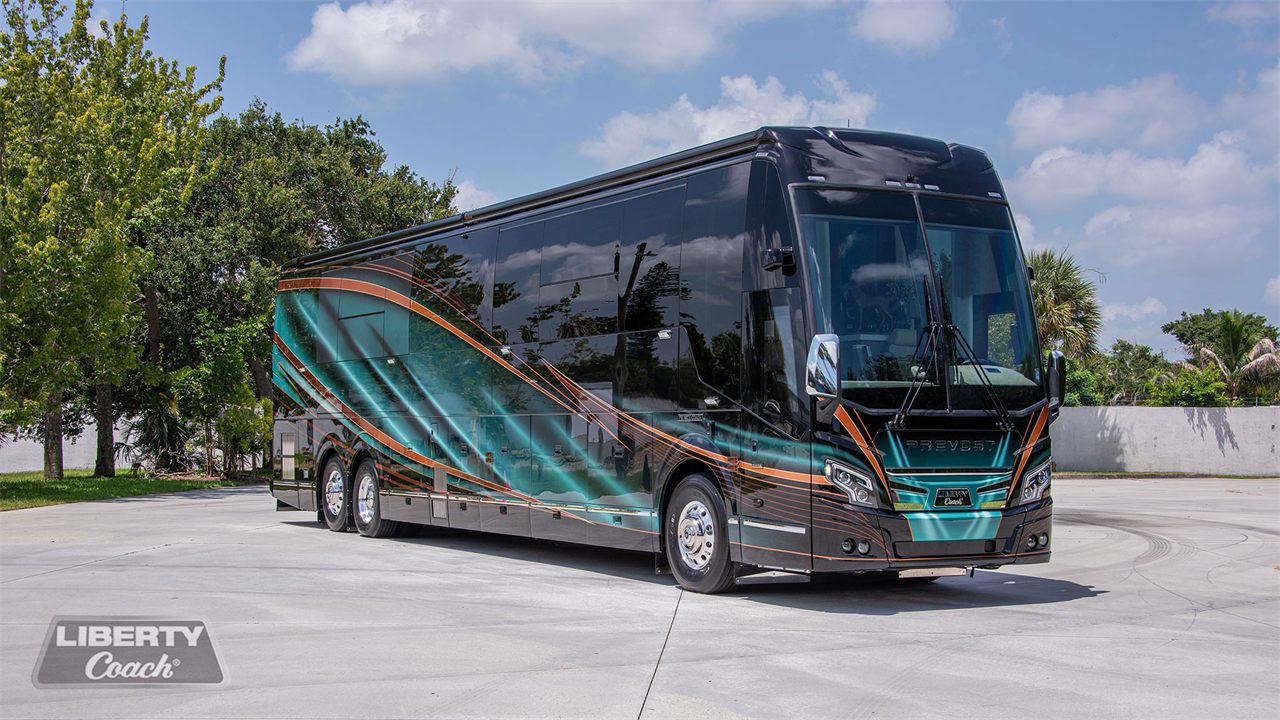
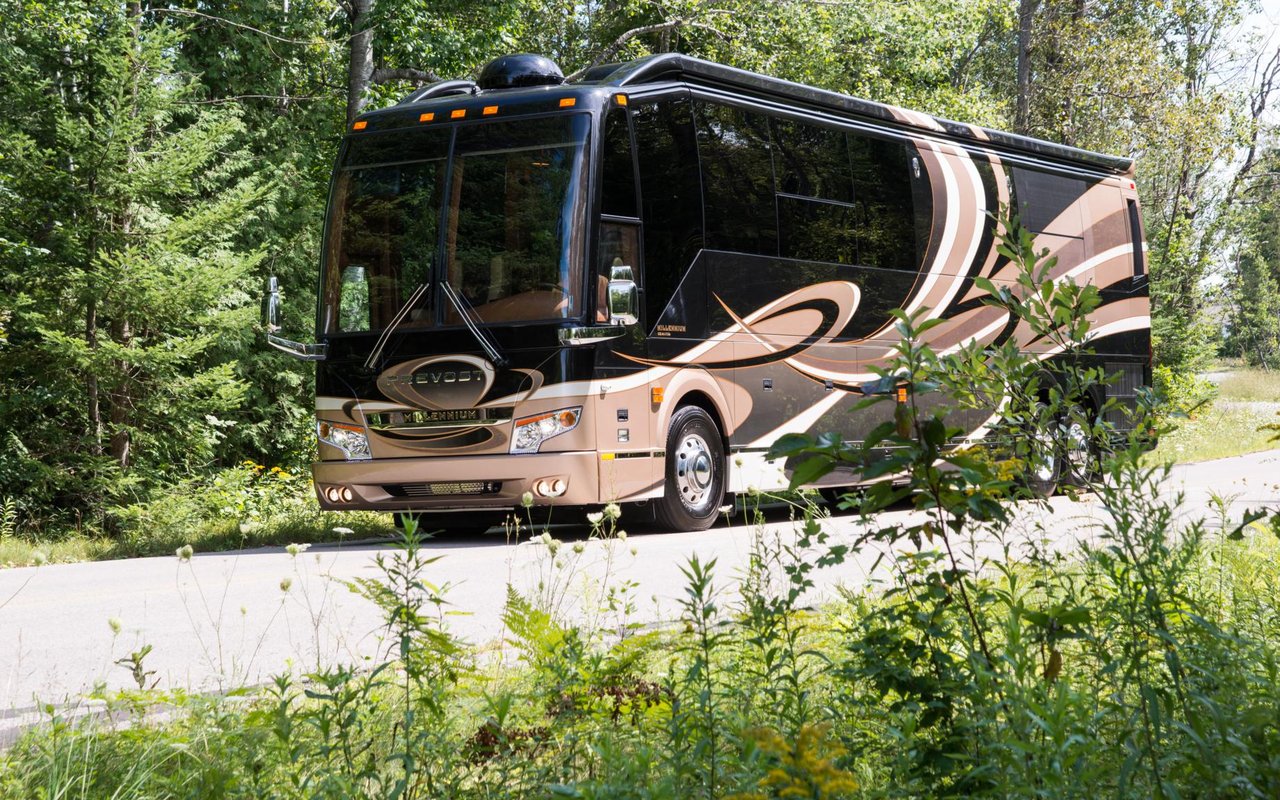
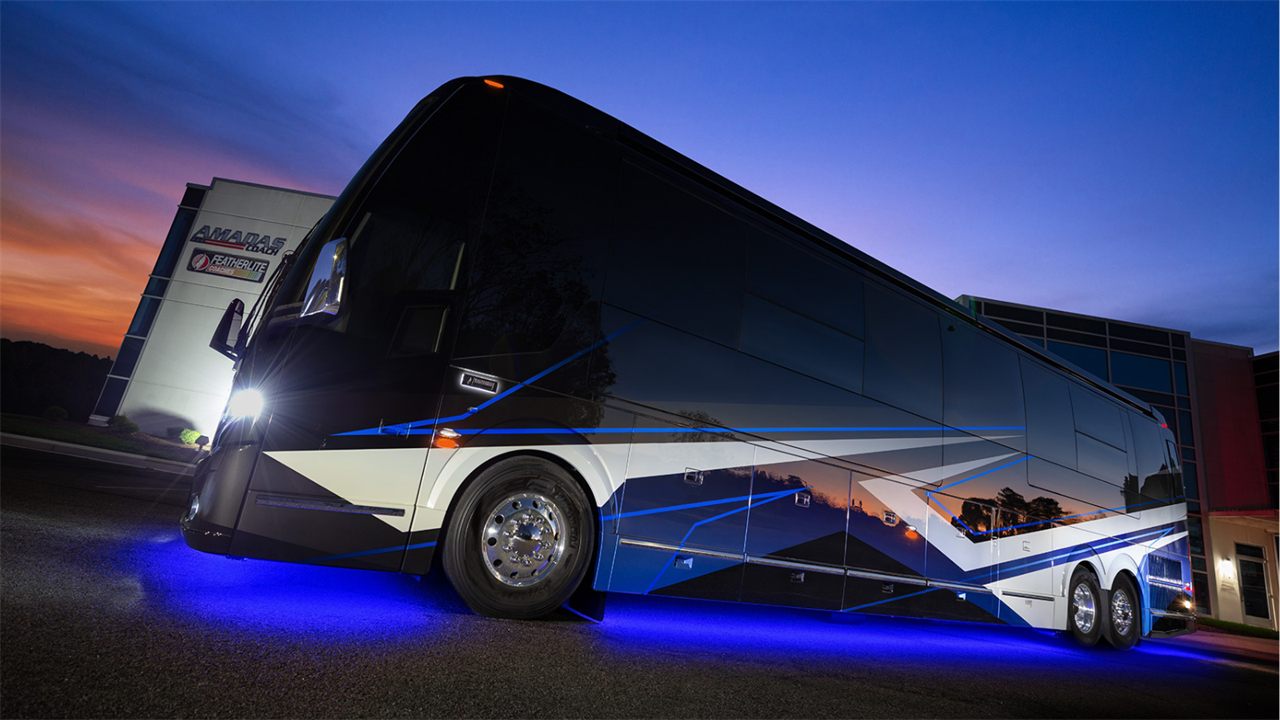
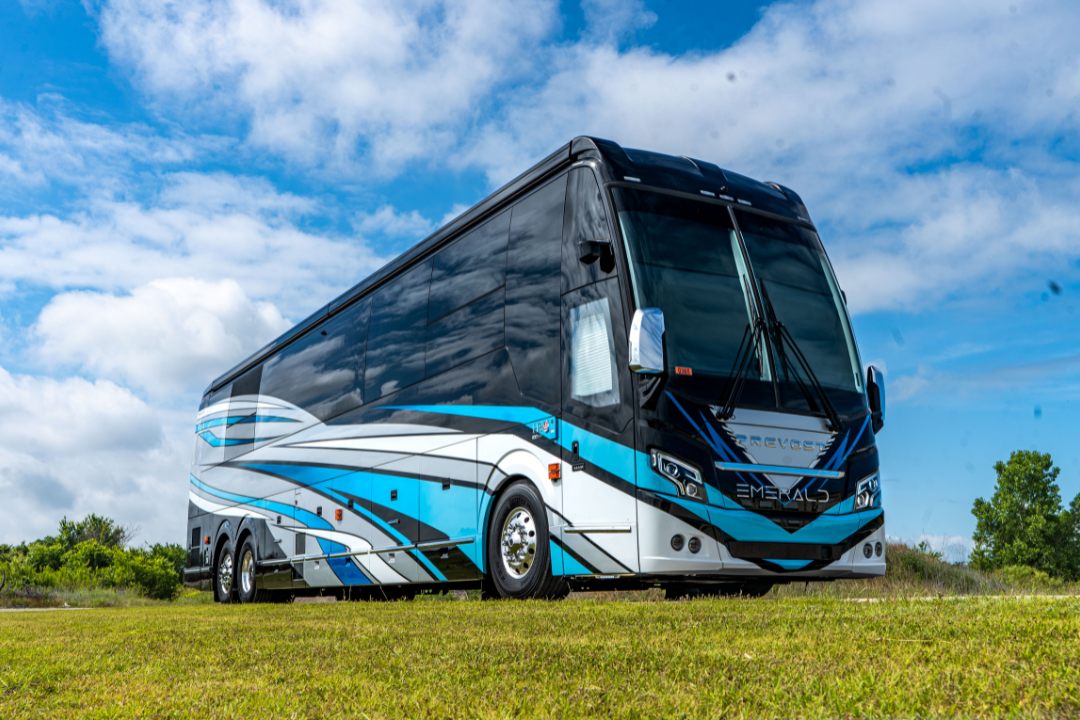
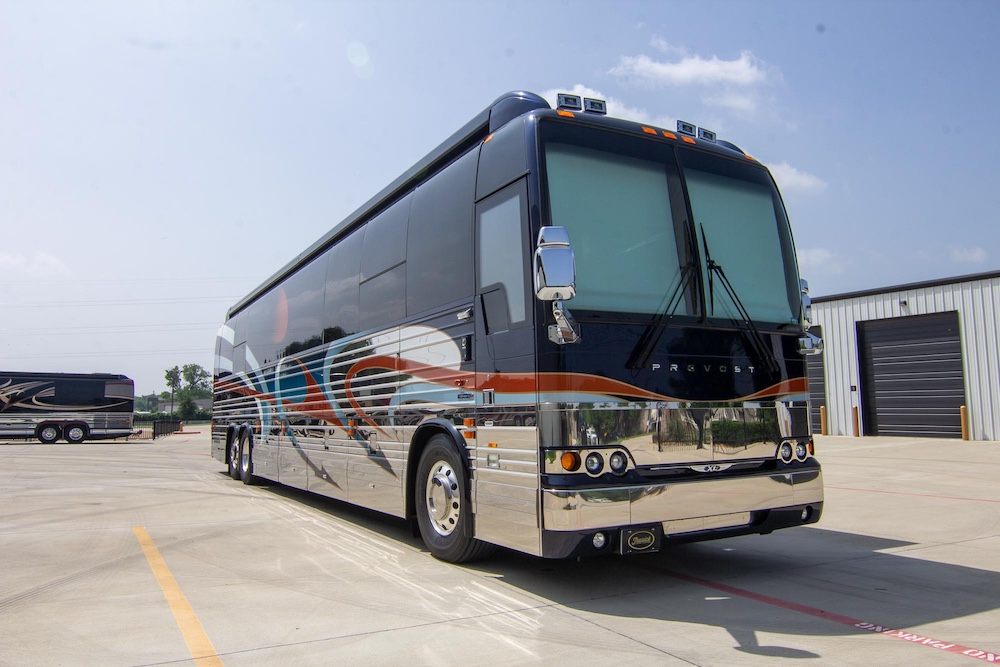
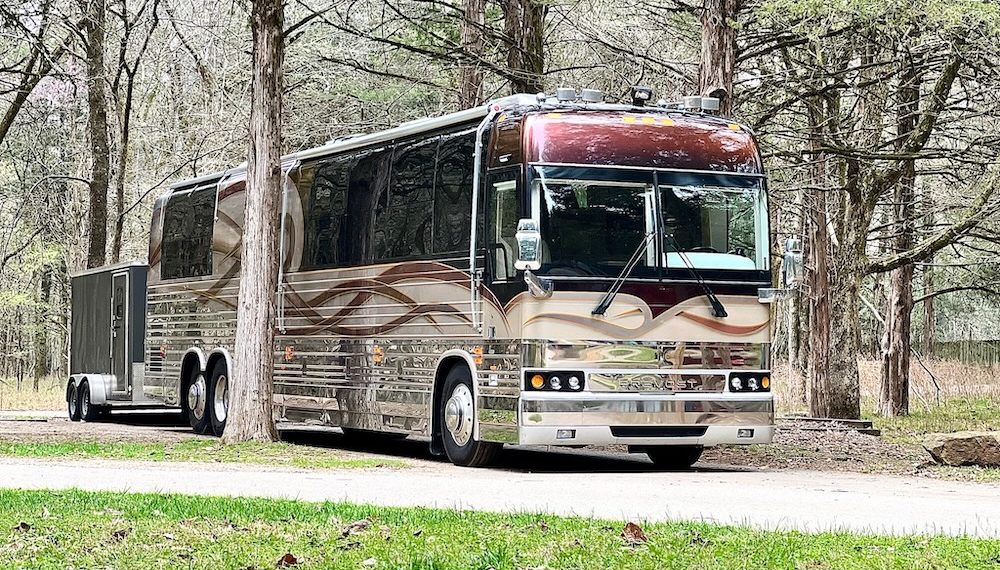
Prevost does not finish motorhomes itself. Its motorhome website names five converter partners that do: Marathon Coach, Liberty Coach, Emerald Luxury Coaches, Millennium Luxury Coaches and Featherlite Coaches. Prevost shells are also finished as entertainer coaches for touring performers. Wikipedia says the two heavily modified buses the US Secret Service introduced in 2011 are X3-45 VIP shells fitted out by Hemphill Brothers Coach Company of Nashville.
Prevost introduced a redesigned H3-45 in 2023 and marked its 100th year in 2024. Its main factory is still in Sainte-Claire.
- 1924First coach body
Eugène Prévost, a cabinetmaker who made church pews and school furniture, is commissioned to build a wooden coach body and mount it on a new REO truck chassis. Source ↗
- 1937First bus plant
The company builds a bus manufacturing plant in Sainte-Claire, Quebec. Source ↗
- 1957Paul Normand buys the company
Paul Normand acquires the business and renames it Prevost Car Inc. Source ↗
- 1966Champion coach
Prevost introduces the Champion, which it describes as the first North American coach with an integral structure. It has three axles, a split-level floor and air conditioning. Source ↗
- 1969American partners join
Thomas B. Harbison and William G. Campbell, two American businessmen, form a partnership with André Normand to own Prevost. Source ↗
- 1970First Champion conversion shell
The first Champion conversion shell leaves the assembly line. Source ↗
- 1976Le Mirage unveiled
Prevost unveils the Le Mirage, with side windows that wrap up into the roof. Source ↗
- 1978Le Mirage shell shown to motorhome owners
The first Le Mirage conversion shell is introduced at the Family Motor Coach Association meeting. Co-owners Thomas Harbison and William Campbell, both longtime motorhome owners, contributed to its engineering. Source ↗
- 1984Wide-body XL
Prevost introduces the Le Mirage XL and the Prevost XL, which it calls the first 102-inch wide-body coaches and conversion shells in North America. Source ↗
- 1985H-Series begins
Prevost introduces the H5-60, a 60-foot articulated bus for 72 passengers and the first of its H-Series. Source ↗
- 1989H3-40
Prevost launches the H3-40 touring coach, along with H3-40 bus shells for high-end conversion. Source ↗
- 1992XL-45 for entertainers
Prevost introduces the 45-foot XL-45 for traveling entertainers. Source ↗
- 1993H3-45 VIP shell
Prevost launches the H3-41 and H3-45 touring coaches and the H3-45 VIP bus shell. Source ↗
- 1995Volvo and Henlys take ownership
Volvo of Sweden and Henlys Group of the United Kingdom acquire joint ownership of Prevost. Source ↗
- 2000Le Mirage XLII
Production of the Le Mirage XLII starts in January. Source ↗
- 2004Volvo becomes sole owner
In October, Volvo agrees to buy Henlys Group's half of Prévost Car Inc. for 83 million US dollars, a price that includes two loans Henlys had made to the company. Prevost is to become a wholly owned subsidiary of Volvo Bus Corporation. Source ↗
- 2006X3-45
Prevost launches the X3-45, which it says has the longest wheelbase in the industry. Source ↗
- 2010Volvo D13 engine across the line
Prevost announces that all of its vehicles will be built with the Volvo D13 engine. Source ↗
- 2023Redesigned H3-45
Prevost introduces an all-new H3-45. Source ↗
- 2024100 years
Prevost marks the 100th anniversary of Eugène Prévost's first wooden coach. Source ↗
Who finished the coach
The converters
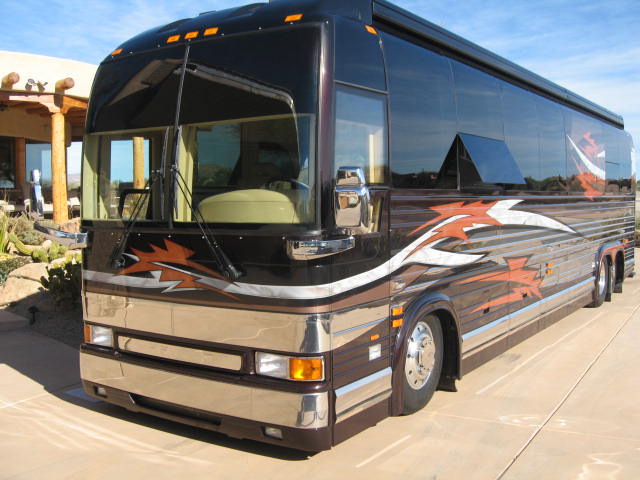
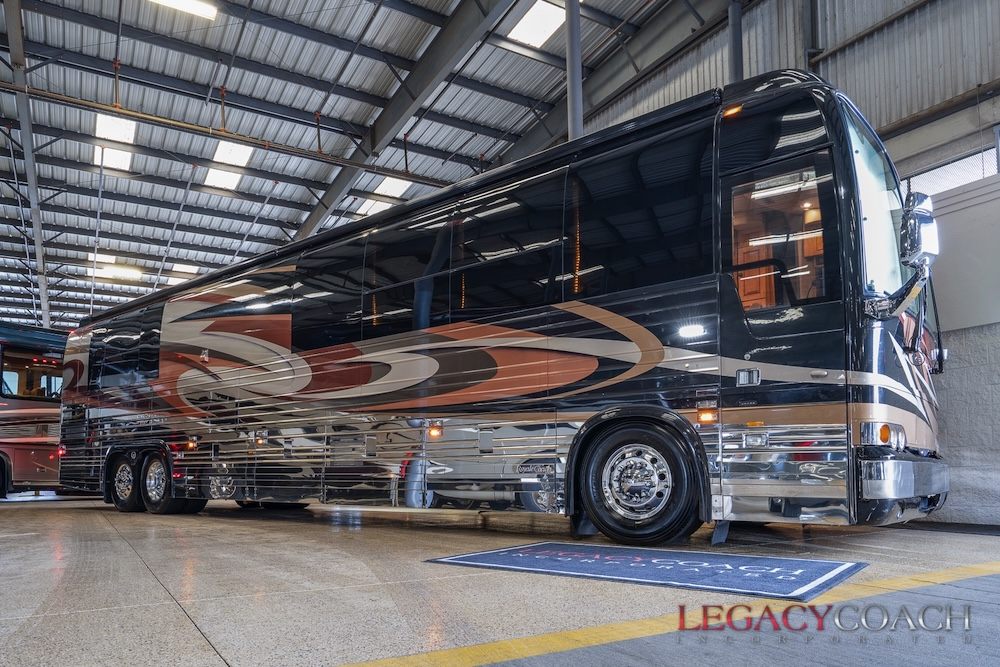
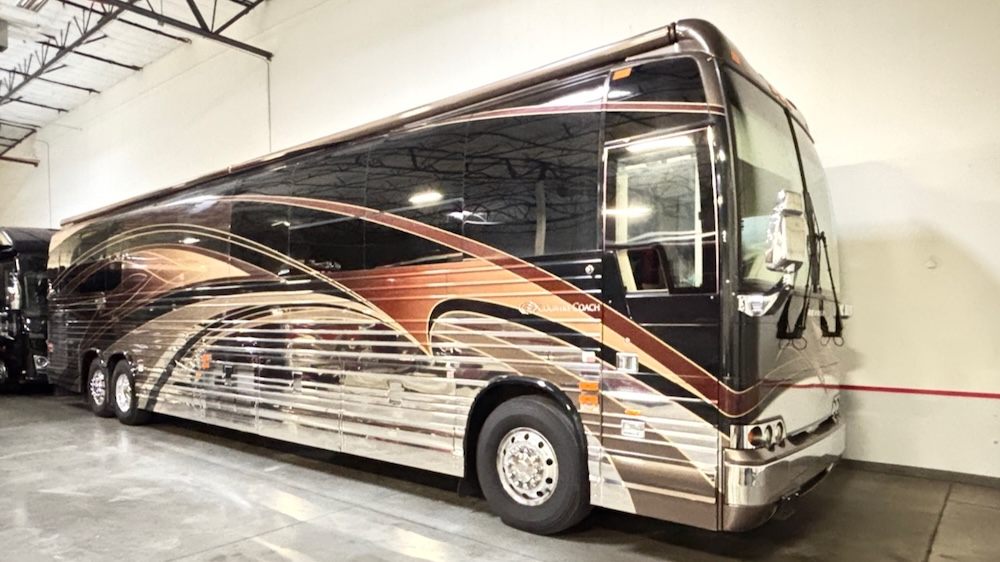
A Prevost shell leaves the factory empty inside. One of these companies builds the living space.
Guides
- How a Prevost bus becomes a motorhome — Prevost builds passenger buses in Quebec. It also sells bus shells with nearly empty cabins that other companies finish as luxury motorhomes. Here is how that two-step process works, how the two current shells differ, and what a buyer should ask for.
Brochures and sources
- Our Story | Prevost Motorhomes ↗
- Our Story / Prevost Motorhomes ↗ — Prevost's own motorhome history timeline: 1924 first coach body, 1966 Champion, 1970 first conversion shell, 1978 Le Mirage shell, 1984 wide-body XL, 1993 H3-45 VIP, 2000 XLII, 2006 X3-45.
- Why Prevost / Prevost Motorhomes ↗ — Side-by-side figures for the H3-45 VIP and X3-45 VIP shells (interior height, pre-conversion height, wheelbase, underfloor storage) and links to the current specification sheets.
- Motorhome Converters / Prevost Motorhomes ↗ — Prevost's list of converter partners: Marathon Coach, Liberty Coach, Emerald Luxury Coaches, Millennium Luxury Coaches and Featherlite Coaches, with locations and short company notes.
- Free Resources / Prevost Motorhomes ↗ — Download page for the H3-45 VIP and X3-45 VIP specification sheets, the VIP driver's guide and the features brochure.
- Prevost H3-45 VIP Specification 2023 (PDF) ↗ — Prevost shell specification sheet for the H3-45 VIP, labeled 2023. Fuel tank shown as 222 US gallons.
- Prevost H3-45 VIP Specification 10.2023 (PDF) ↗ — October 2023 revision of the H3-45 VIP shell specification sheet. Fuel tank shown as 200 US gallons.
- H3-45 VIP Specification Highlights, 03/21 (PDF) ↗ — Prevost shell specification sheet for the H3-45 VIP printed March 2021.
- Prevost X3-45 VIP Specification 2023 (PDF) ↗ — Prevost shell specification sheet for the X3-45 VIP, labeled 2023.
- Prevost H3-45 Specification 2023, passenger coach (PDF) ↗ — Specification sheet for the 56-seat passenger H3-45. Useful for comparing the passenger coach with the VIP shell.
- Prevost X3-45 Specification 2023, passenger coach (PDF) ↗ — Specification sheet for the 55-seat passenger X3-45. Useful for comparing the passenger coach with the VIP shell.
- Top 15 Features Exclusive to a Prevost (PDF brochure, 2017) ↗ — Prevost motorhome brochure describing the integral stainless-steel structure, the frame reinforcement used for slide-outs, the Volvo D13 engine and the service network.
- Volvo takes over Prévost and Nova Bus / Volvo Group press release, 18 October 2004 ↗ — Volvo's announcement that it bought the remaining half of Prévost Car Inc. from Henlys Group for 83 million US dollars.
- AB Volvo Form 6-K, October 2004 / US Securities and Exchange Commission ↗ — Volvo's regulatory filing covering the Prévost Car Inc. purchase and describing what Prevost and Nova Bus build.
- Volvo becomes sole owner of Prevost, Nova / METRO Magazine, 18 October 2004 ↗ — Trade-press report of the 2004 purchase, noting that Volvo had been a 50 percent owner with Henlys since 1995.
- Prevost Celebrates 100 Years / Volvo Group, January 2024 ↗ — Founding story and early milestones (1924, 1937, 1945, 1957) as told by Prevost's parent company.
- Prevost Celebrates 95 Years / Volvo Group, August 2019 ↗ — Company description: premium intercity touring coaches and conversion coaches, with main manufacturing in Sainte-Claire, Quebec.
- Prevost Celebrates 100 Years / BUSRide, 5 January 2024 ↗ — Long trade-magazine history of Prevost by decade, including owners, presidents, models and the 2023 H3-45.
- Prevost celebrates its first 90 years / BUSRide, 1 February 2014 ↗ — Year-by-year trade-magazine timeline from 1924 to 2013.
- Prevost (bus manufacturer) / Wikipedia ↗ — Encyclopedia article with model and ownership history, including the Champion, the Le Mirage, the 2008 change to the Volvo D13 engine and the Secret Service buses.
- Prevost H-Series / Wikipedia ↗ — History of the H5-60, H3-40, H3-41 and H3-45, including the VIP conversion shell.
- Prevost X-Series / Wikipedia ↗ — History of the Le Mirage, XL, XL-45, XLII and X3-45, including the VIP conversion shells.
- Motorhome Clubs / Prevost Motorhomes ↗ — Prevost's list of owner clubs, including the Prevost Motorcoach Club, Prevost Owners Group and Prevost Community.
- Prevost For Sale / Prevost-Stuff ↗ — Large independent listing page for used Prevost conversions. Shows how coaches are named by year, converter, shell model and slide count. Not a Prevost company site.
- Prevost recalls by model / Justia ↗ — Index of US safety recall records by Prevost model name and model year, including the VIP and Entertainer shells.
Links open the original page. Facts are checked against these sources; tell us if you find one that is out of date.
Photo credits
Liberty Coach: Liberty Coach · All rights reserved (source) · Marathon Coach: Motormadness · Public domain · Wikimedia Commons (source) · Millennium: Bob Maxon · CC BY-SA 3.0 · Wikimedia Commons (source) · Featherlite: Featherlite Coaches · All rights reserved (source) · Emerald: Emerald Luxury Coaches · All rights reserved (source) · Parliament: Prevost-Stuff.com listing · All rights reserved (source) · Angola: Prevost-Stuff.com listing · All rights reserved (source) · Royale: Legacy Coach via Prevost-Stuff.com · All rights reserved (source) · Country Coach: Prevost-Stuff.com listing · All rights reserved (source)
Prevost coaches for sale
See Prevost listings in the Motorcoach.direct marketplace.